Return to Core
PyTorchOCRDevanagari
ScriptNet OCR
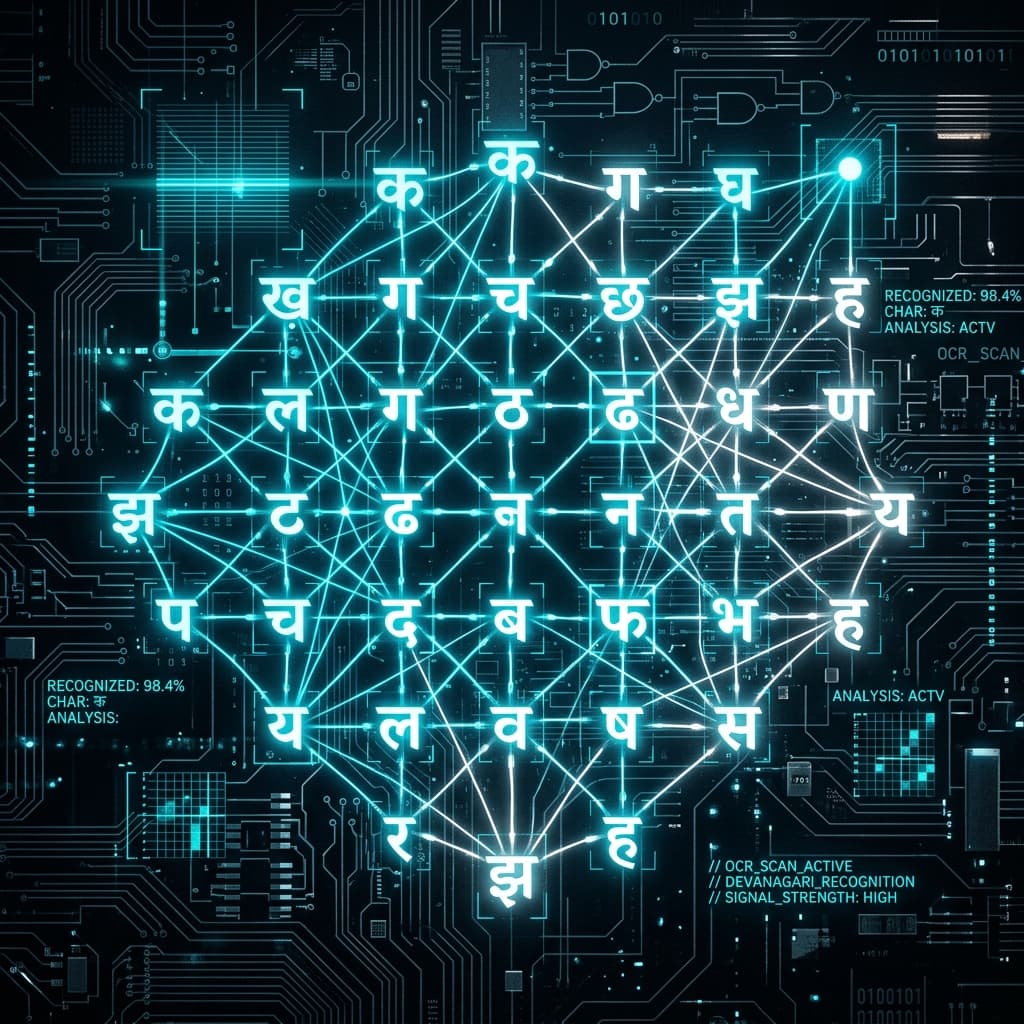
Devanagari OCR that survives skew, noise, and bad lighting—before the model ever runs.
Problem
- Devanagari text in the wild is skewed, noisy, and inconsistently lit—raw OCR fails fast.
- Datasets are imbalanced for regional scripts, making general models unreliable.
Build
- Preprocessing pipeline (OpenCV) to normalize, deskew, and denoise before recognition.
- STN-based alignment + PyTorch backbone + tuned Tesseract v5 config for Nepali.
Outcome
- More stable extraction on degraded scans and photos.
- Reported 92% validation accuracy on battered control sets.
The thread
Tasked with a complex requirement to expand global AI accessibility, ScriptNet OCR was modeled to specialize fundamentally in regional script extraction from heavily degraded structural forms.
Specifically tuned for Devanagari script detection and recognition, overcoming severe dataset imbalances intrinsic to localized dialects.
Engineered an automated preprocessing pipeline utilizing OpenCV to normalize contrast, desew grids, and eliminate artifacts before forwarding the data structures to optimized Tesseract binaries for Nepali text extraction, yielding a 92% validation accuracy against synthetically battered control sets.
Architecture Overview
- //Spatial Transformer Networks (STN) for skew alignment
- //PyTorch implementation utilizing ResNet34 backbone
- //Custom Tesseract OCR v5 configuration